
Health Canada’s TVPA third legislative review acknowledged cigar-specific feedback, but Canada still needs a distinct, evidence-based policy conversation for premium cigars.
This review should be read carefully. It is not simply another federal report. For Canada’s premium cigar sector, it is a formal acknowledgement that cigars raise a distinct regulatory issue, and that the issue still requires a real policy answer.
The report of the third legislative review was tabled in Parliament on May 20, 2026. Health Canada stated that the review focused on compliance and enforcement of the Tobacco and Vaping Products Act, commonly known as the TVPA, and identified areas for potential action to strengthen Health Canada’s enforcement approach.
That context matters. This was not a complete cigar-specific regulatory review. It was not a full reconsideration of every tobacco product category. It was not a detailed examination of the premium cigar market, specialty cigar retail, cigar packaging realities, or adult cigar consumer behaviour.
And yet, premium cigars still made it into the final report.
That is important.
It means the issue is now on the public record.
What the TVPA Third Legislative Review Says About Cigars
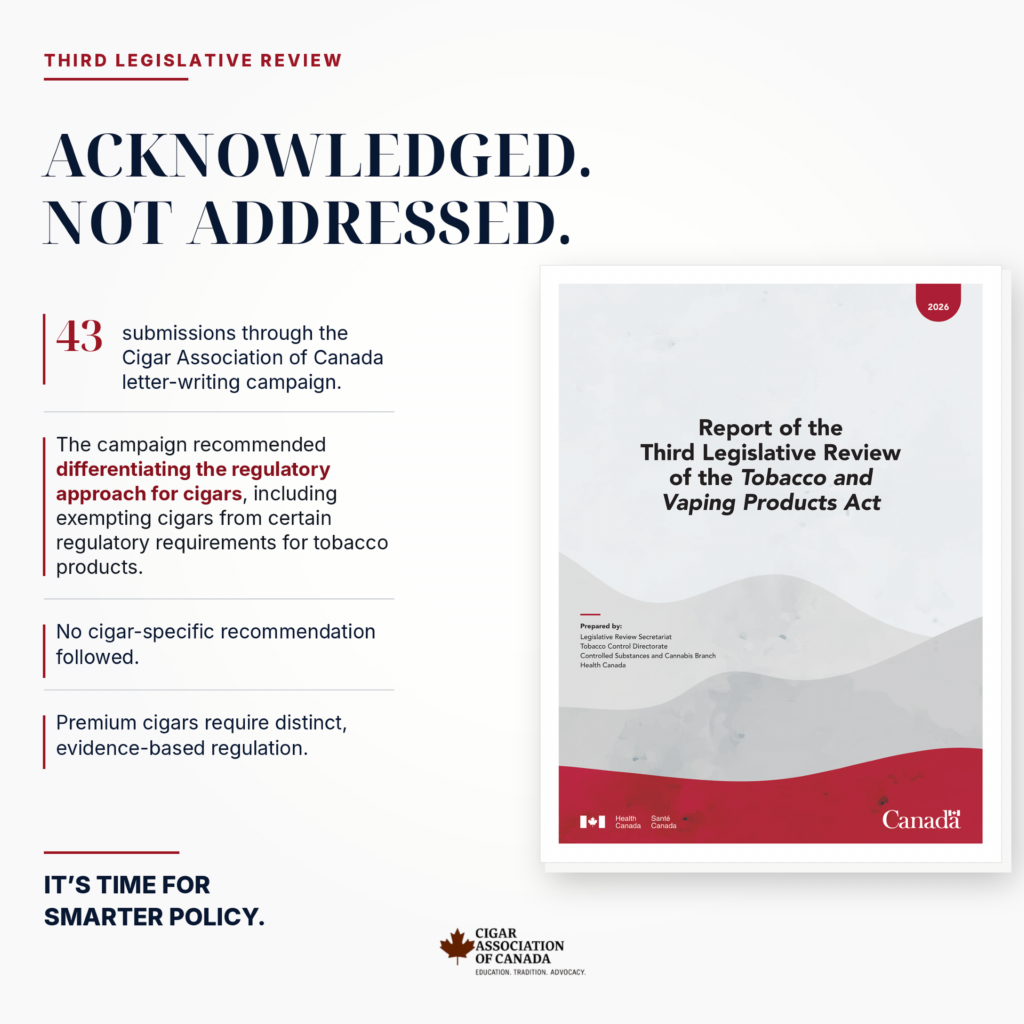
Health Canada received 165 written submissions through the third legislative review process. In the report’s submission chart, 43 submissions were identified under the category “Letter-writing campaign.” The report’s footnote states that these submissions were received from industry and the general public using templated wording related to the regulation of cigars.
Through the Cigar Association of Canada’s letter-writing campaign, stakeholders asked for a differentiated regulatory approach to cigars. Health Canada’s final report records that the letter-writing campaign recommended “differentiating the regulatory approach for cigars,” including “exempting cigars from certain regulatory requirements for tobacco products.”
That is the central point.
Cigar stakeholders did not merely object to regulation. They advanced a specific policy argument: cigars should be treated as a distinct category within Canada’s tobacco regulatory framework.
The final report acknowledged that argument.
But acknowledgement is not resolution.
Acknowledged, But Not Addressed
The cigar recommendation appears in the report under “Other feedback received.” That section explains that some feedback proposed regulatory changes that fell outside the scope of this review. It then notes the cigar-specific recommendation and states that these suggestions will continue to be assessed and considered, where appropriate.
That is procedurally understandable. A compliance and enforcement review has a defined scope.
But it is not enough.
A matter can fall outside the immediate scope of one review and still deserve serious follow-up. When a statutory review records a category-specific concern, the responsible policy response should not be to let the issue disappear into a section called “Other feedback received.” It should be to create a proper process for examining the issue on its merits.
That is especially true where the concern is not abstract. The cigar issue goes directly to proportionality, classification, compliance burden, specialty retail, adult consumer access, and the practical design of enforcement.
Premium cigars are already regulated.
The question is whether they are being regulated intelligently.
Why the Five-Year Review Cycle Matters
The timing of this review matters.
The federal government has proposed changing the TVPA legislative review cycle from two years to five years going forward. Bill C-31, the Budget 2025 Implementation Act, No. 2, proposes to amend the TVPA so that future reviews of the Act would occur within five years after the previous review report has been tabled, rather than every two years.
That proposed change makes the cigar issue more urgent, not less.
If the formal legislative review cycle becomes longer, unresolved category-level problems may have fewer structured opportunities for reconsideration. A cigar-specific concern acknowledged in 2026 should not simply be deferred into a longer review horizon without consequence.
The longer the review cycle, the stronger the case for action between reviews.
Canada should not wait five years to begin asking whether premium cigars are being regulated through the right legal and policy lens.
Category Matters
Good regulation begins with accurate classification.
The TVPA regulates the manufacture, sale, labelling, and promotion of tobacco products and vaping products sold in Canada. CAC supports responsible regulation, youth protection, lawful compliance, and evidence-based decision-making.
But legitimate public health objectives do not eliminate the need for proportional regulation. A public health framework is strongest when it distinguishes between different products, different risks, different retail environments, and different patterns of consumer behavior.
That is the central policy issue.
A regulatory framework that treats unlike products as identical is not necessarily stronger. It may simply be less precise.
Premium cigars are not mass-market cigarettes. They are not vaping devices. They are not convenience-store impulse products. They are a distinct adult-oriented category typically associated with specialty retail, different purchasing behavior, different use patterns, and different market dynamics.
That distinction does not mean premium cigars should be unregulated.
It means they should be regulated in a way that reflects what they are.
Proportionality Is Not Deregulation
The cigar sector is not asking for an absence of rules. It is asking for rules that make sense.
There is a critical difference between deregulation and proportionate regulation.
Deregulation means removing rules without regard to risk.
Proportionate regulation means making the rules fit the category, the evidence, the risk, and the actual compliance reality.
That distinction should matter to Health Canada, Parliament, regulators, retailers, and the public.
A cigar-specific policy conversation would not weaken public health. Properly designed, it would strengthen regulatory coherence. It would allow government to focus enforcement resources where the evidence shows greater risk, while avoiding unnecessary burdens on lawful, adult-focused specialty businesses.
That is not a retreat from public health.
That is better governance.
The Report Supports a More Targeted Approach
The third legislative review repeatedly emphasizes enforcement focus, risk, compliance capacity, and practical tools. Health Canada identifies major areas for potential action, including oversight of a changing market, regulation in a digital era, collaboration through the legislative framework, and expanded compliance and enforcement tools.
The logic of the report is clear: enforcement should be effective, proportionate, modern, and focused.
That same logic should apply to premium cigars.
Regulatory design should not assume that every tobacco category presents the same risk, the same enforcement challenge, or the same compliance profile.
If enforcement should be risk-based, regulation should be category-aware.
The Premium Cigar Issue Is a Classification Issue
Premium cigars are often forced into broad tobacco regulatory categories designed around products with different public health, retail, packaging, and consumer profiles.
That creates a classification problem.
When law classifies too broadly, it risks overreach. When regulation ignores meaningful distinctions, it can impose costs without corresponding public benefit. When compliance systems are not designed around real-world business practices, regulated parties may face unnecessary complexity even when they are operating in good faith.
A smarter approach would ask practical questions.
What requirements are genuinely necessary for premium cigars?
Which requirements are aimed at risks that are not meaningfully present in the same way for premium cigars?
Which rules impose disproportionate burdens on specialty cigar retailers and importers?
Which requirements protect youth and public health without unnecessarily disrupting lawful adult commerce?
Which cigar-specific exemptions, guidance documents, or compliance pathways would better align the TVPA with its objectives?
These are not anti-regulation questions.
They are responsible regulatory questions.
Youth Protection and Adult Choice Can Coexist
CAC supports youth protection. That principle should be clear and repeated.
But youth protection does not require every tobacco product to be regulated as if it were marketed, sold, purchased, or used in the same way.
A policy framework can protect young persons while still recognizing lawful adult choice and legitimate specialty retail. It can restrict youth access while distinguishing adult-focused premium cigars from products associated with different consumption patterns, different marketing realities, and different compliance concerns.
The strongest regulatory systems are not blunt.
They are disciplined.
They target the risk.
They preserve the objective.
They avoid unnecessary collateral damage.
Enforcement Should Focus on Real Risk
The third legislative review discusses illegal tobacco and vaping products and recognizes that illegal products can undermine tobacco control efforts, affect the regulated market, and harm legitimate businesses.
That point should matter to everyone.
Legitimate specialty cigar retailers are not the illegal market. They are part of the regulated market. They operate under existing laws, age restrictions, packaging requirements, federal rules, provincial rules, municipal rules, excise obligations, and retail compliance expectations.
A strong enforcement framework should focus on non-compliance, youth access violations, illegal supply, illicit products, online evasion, and repeat bad actors.
It should not treat lawful, adult-focused cigar businesses as if they are the policy problem simply because they sell a regulated product.
Precision in regulation is not weakness.
Precision is how enforcement becomes effective.
Article 5.3 and Transparent Consultation
The report notes that Canada is a party to the World Health Organization Framework Convention on Tobacco Control and that Article 5.3 requires parties to protect public health policies from commercial and other vested interests of the tobacco industry. Health Canada also states that consultation with industry was undertaken in alignment with federal guidance.
Transparency is appropriate. Safeguards are appropriate. Public health policy should be made in the public interest.
But Article 5.3 should not be misunderstood as a command to ignore regulated parties.
Government cannot design workable compliance systems without understanding the markets it regulates. Regulators need evidence about supply chains, product categories, retail realities, packaging constraints, compliance costs, importation issues, and adult consumer behavior.
The answer is not silence.
The answer is transparent consultation.
CAC is not asking for private influence. CAC is asking for a public, evidence-based, cigar-specific policy conversation.
What a Cigar-Specific Policy Conversation Should Include
A serious follow-up process should examine premium cigars on their own terms.
It should consider the structure of the Canadian premium cigar market, including specialty retail, importation, packaging formats, adult consumer behavior, and the realities of compliance for small and medium-sized businesses.
It should examine whether certain tobacco-product requirements are appropriate for premium cigars, whether some are disproportionate, and whether targeted exemptions or alternative compliance pathways would better meet the objectives of the TVPA.
It should distinguish between premium cigars, cigarettes, little cigars, vaping products, and illicit products.
It should assess enforcement priorities based on actual risk and compliance data, rather than assumptions.
It should preserve youth protection.
It should respect lawful adult-focused specialty retail.
It should produce clear recommendations.
Most importantly, it should not wait for the next statutory review cycle.
The Rule-of-Law Argument for Smarter Cigar Policy
At its core, this is a rule-of-law issue.
Regulation should be predictable. It should be rational. It should be tied to evidence. It should be proportionate to the objective. It should distinguish between materially different circumstances.
A category-insensitive framework risks failing those tests.
When government recognizes that a product category is different but does not build a policy process to address that difference, regulated parties are left in uncertainty. When stakeholders participate in a consultation and their concern is acknowledged but not carried forward into a concrete pathway, the consultation process risks becoming incomplete.
That is not the standard Canada should accept.
The third legislative review did something valuable: it recorded the cigar issue.
Now the policy process must do something more valuable: resolve it.
CAC’s Position
The Cigar Association of Canada supports responsible regulation.
CAC supports youth protection.
CAC supports lawful compliance.
CAC supports meaningful consultation.
CAC supports evidence-based decision-making.
But responsible regulation must also be precise.
Premium cigars require a distinct regulatory conversation because they are a distinct category. They should not be collapsed into a one-size-fits-all framework designed around products with different use patterns, different retail channels, different enforcement concerns, and different public policy realities.
The question is not whether cigars should be regulated.
They already are.
The question is whether they should be regulated intelligently.
Conclusion: Acknowledgement Must Become Action
Health Canada’s TVPA third legislative review acknowledged the cigar issue. It recorded 43 letter-writing campaign submissions related to cigar regulation. It recorded the recommendation to differentiate the regulatory approach for cigars, including exempting cigars from certain regulatory requirements for tobacco products.
That acknowledgement matters.
But it is not enough.
With the federal government proposing a longer five-year legislative review cycle, cigar-specific issues should not be deferred indefinitely.
Canada needs a dedicated, evidence-based, cigar-specific policy conversation now.
Not to weaken public health.
Not to avoid compliance.
Not to remove safeguards.
But to make regulation smarter, more proportionate, more enforceable, and more accurate.
Premium cigars require distinct, evidence-based regulation.
The issue has been acknowledged.
Now it must be addressed.
It is time for smarter policy.